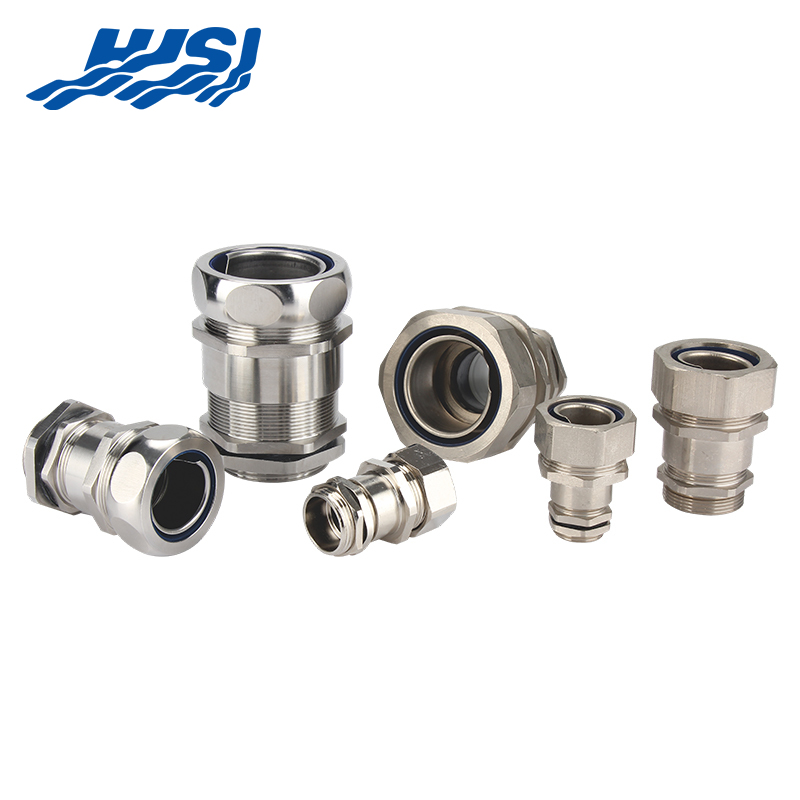
A Stainless Steel Cable Gland joint rarely takes centre stage in a renewable energy plant. It sits inside a tray, dangles from a tower ladder, or rests beneath a battery rack, doing its job quietly while inverters, turbines, and panels claim the spotlight. Yet the moment a joint fails, the entire string can stop delivering power. A single oxidised connection raises resistance, local heating begins, and a monitoring system flags an unexpected loss of yield. Because stainless steel joints resist the corrosion that ruins ordinary ferrous hardware, engineers now treat them as strategic parts of the plant rather than commodity fasteners. Their story unfolds across four overlapping domains: photovoltaic arrays on land, wind turbines on ridgelines and coasts, containerised battery halls, and salt-laden offshore stations.
Stainless steel begins as an iron alloy blended with chromium and nickel. Chromium forms a chromium-oxide film that self-repairs after scratching, while nickel stabilises the austenitic structure so the metal remains non-magnetic and ductile at low temperatures. Cable joints machined from this alloy therefore accept repeated bending, tolerate thermal cycling, and survive chloride atmospheres without the rust bloom that appears on zinc-plated carbon steel. Renewable sites experience daily temperature swings, vibration from rotating machinery, and electrolytes in the form of rain, mist, or sea spray. A joint that keeps its surface intact maintains low electrical resistance, which in turn keeps losses small and heating negligible. Over twenty-five years, the saving in generated kilowatt-hours can outweigh the higher purchase price of the stainless hardware.
A ground-mounted photovoltaic field contains thousands of metres of direct-current cabling. Home-run strings gather at combiner boxes, and parallel feeder cables run to inverters. Every transition from cable to bus-bar, or from feeder to inverter, demands a joint that will not introduce extra resistance. Stainless steel joints serve three specific roles in these arrays.
First, they terminate aluminium conductors inside combiner boxes. Aluminium is light and economical, yet it creeps under pressure and oxidises quickly. A stainless steel crimp sleeve lined with tin-plated insert bites through the oxide during installation, then maintains steady contact pressure as temperatures rise and fall. Because the stainless body does not rust, the connection remains accessible for future re-tightening.
Second, they bond module frames to the earthing network. Each panel sits on an aluminium frame bolted to a galvanized steel rack. Stainless steel joints link the frame to a copper earthing conductor that runs along the row. Galvanic corrosion is suppressed because stainless steel sits near the middle of the galvanic series, reducing the driving voltage between aluminium and copper. The joint therefore preserves both mechanical strength and electrical continuity for decades.
Third, they transition from buried DC cables to above-ground inverters. Buried cables enter a kiosk through a gland plate; stainless steel joints inside the kiosk connect the incoming conductors to flexible copper tails that enter the inverter cabinet. The stainless hardware resists condensation that forms when warm daytime air meets cool night-time metal, preventing the green patina that would otherwise appear on copper lugs.
A wind turbine nacelle tilts and yaws continuously. Cables that run from the generator down the tower must absorb this motion without work-hardening. Stainless steel joints appear at both ends of the loop: inside the nacelle junction box and at the base of the tower.
Inside the nacelle, space is tight and ambient temperatures track generator load. Stainless steel pin-type joints secure fine-stranded copper conductors to bus-bars. The pin design allows the joint to be opened with a single tool during maintenance, yet the stainless body resists fretting corrosion caused by micro-movement between lug and bar. Technicians can therefore isolate the generator without cutting cable ends, reducing downtime.
| Aspect | Description | Benefit |
|---|---|---|
| Installation space | Compact nacelle environment with temperature changes | Requires durable and compact connections |
| Joint structure | Stainless steel pin-type connection | Enables quick opening with one tool |
| Corrosion resistance | Stainless body reduces fretting from micro-movement | Maintains stable electrical contact |
| Maintenance | Joint can be opened without cutting cables | Reduces maintenance time and downtime |
At the tower base, stainless steel joints connect the descending loop to the switchgear. The joint here must tolerate bending cycles imposed by rotor vibration. A crimp ferrule made from stainless steel, paired with a neoprene insert, grips the conductor without cutting strands. Because stainless steel has a coefficient of thermal expansion close to that of copper, the crimp remains snug across the full temperature span from winter nights to full-power afternoons. The absence of loosening keeps resistance low and avoids hot spots that could trigger thermal imaging alarms.
Containerised battery racks operate at several hundred volts of direct current. Cells connect in series and parallel through flexible copper laminates that terminate at stainless steel joints. The joints perform two tasks: carrying continuous current during charge and discharge, and interrupting fault current when a fuse or breaker opens.
During normal operation, batteries heat up internally. Stainless steel joints mounted on aluminium bus-bars expand and contract together with the bus-bar, preventing shear forces that could loosen the interface. A thin silver-plated layer on the joint face lowers contact resistance without relying on tin, which can creep under sustained pressure. The result is a stable millivolt drop that remains within battery management system tolerances for thousands of cycles.
When a fault occurs, the joint must survive the mechanical force produced by magnetic repulsion between conductors. Stainless steel joints, being non-magnetic, avoid the additional forces that ferrous hardware would experience. Engineers often specify a two-bolt pattern that distributes stress across the lug ears, ensuring the joint remains intact until the upstream protective device clears the fault. After the event, the stainless surface can be wiped clean and re-used, whereas a carbon-steel joint might require replacement due to arcing damage.
Offshore substations and floating photovoltaic islands expose every metal part to chloride ions carried by mist and wind. Stainless steel cable joints used in these environments rely on molybdenum-bearing grades that resist pitting corrosion. The joints appear in three zones: deck level, column interior, and seabed cable transition.
On deck, stainless steel joints terminate the array cables that enter the substation roof. The hardware is washed by rain and spray, yet the chromium-oxide film remains intact. Engineers specify joints with integral sealing skirts that shed water away from the bolt heads, preventing the standing electrolyte that would initiate crevice corrosion.
Inside columns, condensation drips slowly for years. Stainless steel joints mounted on cable trays avoid the rust staining that would otherwise migrate onto low-voltage instrumentation wires. Because the alloy is non-magnetic, the joint does not distort the current transformers used for leakage detection, keeping measurement accuracy within specification.
At the seabed transition, stainless steel joints connect the export cable armour to the platform earthing network. The joint is cast into a polyurethane bend restrictor that allows limited movement while blocking seawater. Stainless steel’s resistance to chloride stress corrosion cracking means the joint can tolerate seasonal temperature changes without developing the micro-cracks that would expose the copper conductor to seawater. Over the asset life, this reliability reduces the number of costly subsea interventions.
Stainless steel earns its reputation only when installers respect a few rules. Cutting oils, zinc particles from carbon-steel bolts, and chlorinated cleaners can all break the passive film. Crews therefore dedicate separate tooling for stainless hardware, brush contact faces with a stainless wire brush, and finish with a water-based cleaner that leaves no chloride residue.
| Factor | Risk | Recommended Practice |
|---|---|---|
| Cutting oils | Damage protective surface film | Clean components before installation |
| Zinc particles from carbon steel | Cause contamination | Use dedicated tools for stainless hardware |
| Chlorinated cleaners | Break passive protective layer | Avoid chlorine-based cleaning agents |
| Contact surface condition | Surface contamination affects performance | Brush with stainless wire brush and use water-based cleaner |
Anti-seize compound based on nickel powder prevents galling during tightening, ensuring the bolt can be removed decades later without shearing. Torque is applied in two stages: first to seat the lug, then after five minutes to compensate for relaxation. The disciplined sequence avoids over-compression that could cold-weld stainless threads.
Plant owners compare stainless steel joints to plated carbon-steel alternatives by modelling cost over the project life. The stainless item may carry a higher unit price, yet the spreadsheet adds avoided replacement trips, lost revenue during outages, and the residual value of reusable hardware. In a photovoltaic plant, a single string outage lasting one sunny day can erase the price premium of several stainless joints. In an offshore wind farm, a maintenance vessel mobilisation can outweigh the material cost of an entire array. When these figures are discounted over twenty years, stainless steel joints often display the lower net present cost. The conclusion shifts the item from the commodity column to the risk-mitigation budget.
Stainless steel joints contribute to sustainability targets in two ways. First, they are fully recyclable at end-of-life. Segregated stainless scrap returns to the mill and re-melts into new bar stock with no loss of alloy content. Second, their longevity reduces the number of times technicians must drive or sail to site. Fewer maintenance trips translate into lower fuel burn and lower Scope 3 emissions. Some owners document the avoided journeys in their annual sustainability report, turning a humble cable joint into a line item that supports green financing covenants.
Renewable plants are growing in unit capacity. Solar arrays now reach the kilovolt range, wind turbines approach twenty megawatts, and battery racks exceed one megawatt-hour per container. Higher currents mean larger conductors and higher fault levels. Stainless steel joints will evolve toward multi-bolt designs that spread force across wider lugs, and toward hybrid inserts that combine copper for conductivity with stainless steel for strength. Offshore floating substations will demand joints that tolerate constant motion, leading to flexible braid transitions captured inside stainless steel ferrules. Meanwhile, hydrogen produced by surplus renewable power will require stainless joints that resist embrittlement in the presence of trace electrolytes. Each challenge keeps the humble joint at the centre of system reliability.
Thus, while the megawatt-scale turbines and vast photovoltaic arrays capture our imagination, the resilience of our renewable energy infrastructure is often secured by components measured in millimeters and ounces. Companies like Zhejiang HJSI Connector Manufacturing Co., Ltd., through their specialization in manufacturing stainless steel cable glands and related wiring accessories, embody this critical, ground-level partnership.
Their focus on producing components that offer tensile strength, and resistance to water, dust, salt, and corrosion speaks directly. By committing to the principles of quality, safety, and reliability in creating these essential connecting parts, such manufacturers provide the durable, unseen foundations upon which solar fields, wind farms, and battery storage systems can perform reliably for decades. In the end, the successful harvest of wind and sun relies not only on grand engineering but also on the assured integrity of every small link in the chain—a integrity that dedicated production and processing strive to guarantee.

2nd Floor, Building 2, No. 188, Punan 3rd Road, Economic Development Zone, Yueqing City, Wenzhou City, Zhejiang Province, China

Copyright @ Zhejiang HJSI Connector Co., Ltd. All rights reserved.

China Waterproof Breathable Valve Manufacturer
 +86-15858552966
+86-13356176555
+86-15858552966
+86-13356176555
 English
 русский
 عربى
عربى