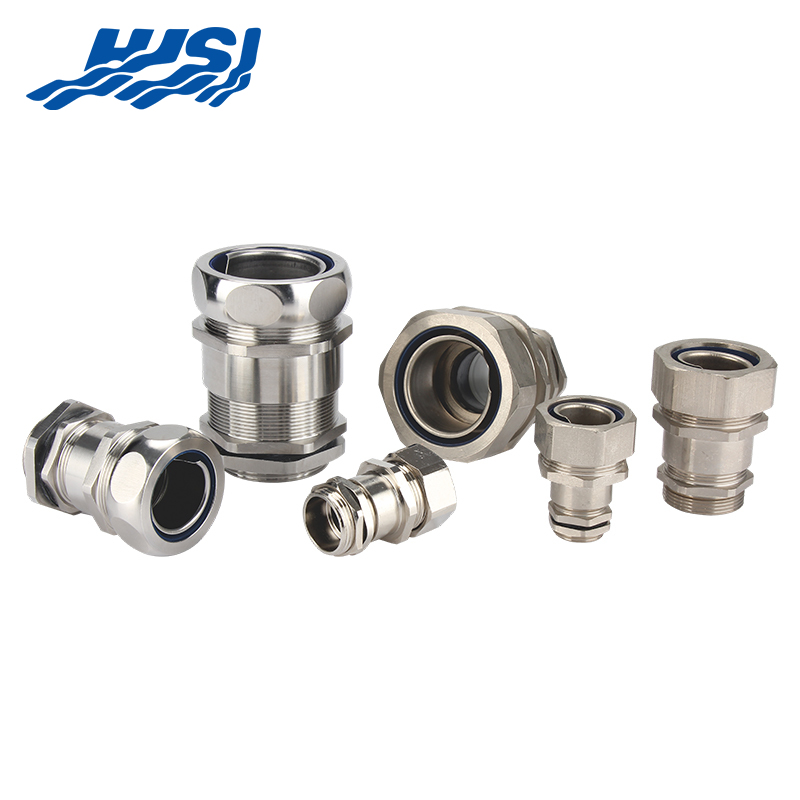
Conductive elements in EMC Cable Gland are the parts that handle the electrical grounding of the cable shield. They create a reliable path for noise currents to flow to the enclosure ground, helping to keep electromagnetic interference from affecting the signals inside the cable.
When a cable enters an enclosure, the shield around it is supposed to block outside noise or stop internal signals from leaking out. But the shield only does its job if it has a good connection to ground. That's the main role of the conductive elements. They press against the shield—whether it's a braid, foil, or tape—and link it to the metal connector body, which then connects to the enclosure. If that link is solid, noise gets shunted away harmlessly. If the contact is spotty or weakens over time, interference can sneak in, causing signal errors, equipment glitches, or even safety issues in some systems.
These elements do more than just provide a wire-like path. They make multiple contact points so the grounding stays effective even if one spot loses pressure from vibration, thermal expansion, or slight cable movement. In setups where the cable flexes or the equipment shakes, having several touch points means the connection does not rely on a single weak link.
They also help hold the shield mechanically. During assembly or when the cable is tugged, the elements grip the shield so it does not pull away or bunch up. In high-vibration environments, they absorb small shifts without letting go completely.
The conductive elements pair up with the connector's sealing features. Seals keep water, dust, and chemicals out, but the conductive parts keep working even if a tiny amount of moisture gets past. Good conductivity slows down corrosion at the contact points, so the grounding path stays low-resistance for longer.
There are several common designs, each suited to different cable types and working conditions.
Spring fingers are thin metal strips bent into curves or loops that push outward against the shield. Each finger acts like its own little spring, pressing with steady force. The multiple fingers mean that if one lifts slightly from vibration or temperature change, the others still keep the connection. Spring fingers are forgiving with flexible cables because they can move along with the cable without losing contact.
Braided contacts are made from woven metal strands that wrap around the shield. The braid molds itself to the cable's surface, spreading contact over a larger area. If one strand wears or breaks, the rest keep carrying current. This design works well when the shield has an irregular shape or when even grounding across a wide surface is needed for cleaner high-frequency performance.
| Feature | Description (Optimized) |
|---|---|
| Construction | Woven metal strands forming a flexible braid |
| Contact method | Wraps around the shield, conforms to surface |
| Contact area | Large / distributed (spreads over wide area) |
| Redundancy & reliability | Multiple strands — if one breaks, others continue conducting |
| Best suited for | Irregular shield shapes, uneven surfaces |
| High-frequency benefit | Cleaner / more uniform grounding, better HF performance |
Clamping rings are round bands that squeeze the shield against the connector body when the gland nut is turned. The ring applies pressure evenly around the full circle. This type is common with armored cables, where the ring can grip the outer armor layer while still making contact with the inner shield.
Conductive elastomers mix a flexible base with metal particles or fibers. The material deforms to follow the cable's contour and fill small gaps, while the conductive filler carries the current. This combines grounding and sealing in one piece, which reduces the number of separate components and saves space in tight installations.
Tined or serrated contacts have small pointed ridges or prongs that press into the shield surface. The tines cut through thin oxide layers or surface corrosion to reach clean metal underneath. This helps keep resistance low in places where oxidation might build up over time.
Each design has its practical strengths. Spring fingers handle movement and are easy to install. Braided contacts give broad-area contact. Clamping rings offer mechanical strength. Conductive elastomers simplify the assembly. Tined contacts improve reliability in corrosive conditions.
The material choice decides how well the elements conduct electricity, how long they hold their shape, and how they stand up to the environment.
Copper-based alloys are a frequent starting point. Brass is easy to shape and conducts well, so it is often used for stamped spring fingers or clamping rings. Phosphor bronze adds extra springiness, which is helpful for contacts that need to flex repeatedly without losing tension.
Stainless steel resists rust and chemical attack better than copper alloys. It is common in outdoor or industrial settings where moisture, salt, or cleaning agents are present. Its conductivity is lower, but the design can be adjusted to make up for it.
Nickel plating is usually applied over the base metal. Nickel cuts down on surface oxidation and improves wear resistance. It also helps prevent galling when metal parts rub together during assembly or vibration.
In some cases, a thin layer of silver or gold is added. Silver gives very low contact resistance, which helps with high-frequency signals. Gold resists tarnish in clean environments and keeps contact stable over long periods.
Conductive polymers mix metal fillers—such as silver-coated particles or carbon—into a flexible base material. These are lighter and can deform more than pure metals, making them useful in compact or lightweight connectors.
The materials have to be compatible. The conductive element cannot cause galvanic corrosion when it touches the cable shield, the connector body, or the enclosure. In food processing, pharmaceutical, or clean-room environments, materials must avoid releasing particles or substances that could contaminate the surrounding area.
The shape and layout of the conductive elements influence their performance.
Contact geometry determines how pressure is spread. Curved or angled fingers apply force evenly without creating high-stress points on the shield. A larger number of contact points adds redundancy—if one finger lifts slightly, others keep the path open.
The connector body holds the elements in place. Internal grooves, shoulders, or ledges position the contacts precisely. The body is typically metal so it can conduct from the elements to the enclosure wall.
Cable accommodation is a practical factor. Elements need to handle different shield diameters and types. Expandable braids or adjustable rings allow one connector to work with a range of cables.
Vibration and shock resistance depend on how the elements stay in place. Built-in spring tension absorbs movement. Locking features on the nut or additional retaining rings prevent the assembly from loosening.
Temperature changes cause materials to expand and contract. Selecting materials with similar expansion rates helps prevent gaps from forming during heating or cooling cycles.
Installation features make assembly easier. Some elements snap into place. Others have guide marks or color coding to show correct orientation.
These design choices help the elements perform reliably under expected conditions.
How you put the connector together has a big say in whether the conductive elements actually do their job. Start by preparing the cable—strip the outer jacket just far enough to give the shield room to touch the contacts, nothing more. Be careful not to nick the shield strands or scrape the inner insulation; even small cuts can cause problems later. For cables with a braided shield, fold the braid back evenly around the jacket or flare it outward if the connector design calls for it.
Slide the cable into the connector body first, then position it so the shield lines up with the conductive elements. Make sure the braid or foil is sitting where it needs to be before you move to the next step. Tighten the nut slowly, turning it a little at a time. Every few turns, pause and check that the cable is still centered and hasn't started twisting inside the gland. Too much force can crush the shield wires or bend the contacts out of shape.
Once everything is assembled, test the electrical connection with a low-resistance meter. Put one probe on the shield (or the connector body if it's easier) and the other on the enclosure surface. A very low reading means the grounding path is solid. If you're working with a connector that takes more than one cable, double-check that each shield is sitting properly against its own set of contacts.
If you can, run a quick test on the finished setup. A simple continuity check is usually enough, but in noise-sensitive systems, a basic interference or emission test will confirm the elements are doing what they're supposed to. Following these steps carefully from the beginning helps the conductive parts give steady, reliable performance right away.
The conductive elements won't stay good forever without some attention. Check them now and then for obvious wear—look for corrosion spots, pitting on the metal surfaces, discoloration that suggests overheating, or fingers that are bent, broken, or missing. Any of those signs means the grounding path is weaker than it should be.
Clean the contacts with a solvent that won't harm the metal or the surrounding materials. Skip anything abrasive; scratching the surfaces can create tiny high-resistance points that build up noise over time. If the connector feels loose from vibration, snug it back up—but don't crank it harder than necessary.
When resistance starts climbing noticeably or when you can see that the contact points are damaged, it's time to replace the connector or the elements themselves. High noise, intermittent signals, or random glitches often trace back to loose or poor contact pressure. Start troubleshooting there—check if the nut has backed off or if the elements have relaxed from heat cycles.
Regular testing during routine maintenance spots problems early, before they turn into bigger headaches.
Conductive elements make EMC connectors useful across a range of industries.
In manufacturing plants, they ground the shields on motor drive cables and sensor wiring, cutting down on electrical noise inside control panels.
Telecommunications equipment uses them to keep signals clean in base stations, routers, and data centers where interference from nearby transmitters can be a constant issue.
Transportation systems—cars, trucks, trains—rely on them because vibration is always present. The elements stay in contact even when the vehicle is moving or the tracks are rough.
Renewable energy setups, like wind turbine nacelles or solar inverter cabinets, need them to handle weather exposure and temperature swings while keeping the electronics quiet.
Medical devices depend on them for clear, stable signals in monitoring equipment where even small interference can affect readings.
Every industry tweaks the design of these elements to match its own conditions—vibration in one place, moisture in another, high frequencies somewhere else.
When the conductive elements are built right, they lower the overall noise in the system, which means fewer random errors and smoother running equipment.
They help the connector last longer by resisting wear, oxidation, and fatigue.
Designs that adapt to different cable sizes and types make it easier to keep parts in stock without needing dozens of variations.
Fewer failures over time cut down on maintenance calls and downtime.
Solid grounding adds a layer of safety by reducing the chance of electrical faults or unexpected behavior.
Keeping steady contact when things vibrate a lot or when temperatures swing from hot to cold is tricky.
Better materials and coatings usually cost more.
Cables come in so many types—braided, foil, armored—that one element design doesn’t fit everything.
People sometimes install them incorrectly, which weakens the grounding right from the start.
Good planning, proper training, and careful selection help work around these issues.
| Challenge | Description (Optimized) | Mitigation / Solution |
|---|---|---|
| Vibration resistance | Maintaining steady contact during heavy vibration | Use resilient spring or braided designs |
| Temperature extremes | Contact reliability during large hot/cold swings | Select materials with matched thermal expansion |
| Higher cost of better options | Superior materials and coatings increase price | Balance performance needs vs. budget |
| Cable shield variety | Braided, foil, armored — no universal contact fits all | Choose gland with adaptable contact types |
| Incorrect installation | Poor prep or tightening weakens grounding from day one | Proper training + step-by-step procedures |
| Overall approach | — | Good planning, training, and careful selection |
People are looking into materials that can self-adjust their pressure or even repair small damage on their own.
New coatings might keep contact resistance lower for longer periods, meaning less frequent cleaning or replacement.
Some designs could include tiny sensors that watch the contact quality and send an alert if it starts to drop.
Materials with a smaller environmental footprint are getting more attention.
All of these point toward connectors that are more dependable and easier to maintain down the road.
With a clear emphasis on well-constructed conductive elements, reliable shield grounding, thoughtful material choices, and designs that balance environmental protection with electromagnetic compatibility, HJSI components support secure cable entries in demanding settings—whether in noisy industrial panels, vibration-heavy machinery, outdoor enclosures exposed to weather, or sensitive equipment where signal clarity matters.
The focus remains on straightforward engineering that handles real-world stresses like temperature shifts, mechanical movement, and long-term exposure while keeping installation and maintenance manageable. For engineers and technicians looking for dependable EMC cable connectors that prioritize grounding integrity, durability, and ease of use over gimmicks or overpromising, HJSI offers a solid, no-nonsense option that helps electrical systems stay stable and interference-free—one reliable connection at a time.

2nd Floor, Building 2, No. 188, Punan 3rd Road, Economic Development Zone, Yueqing City, Wenzhou City, Zhejiang Province, China

Copyright @ Zhejiang HJSI Connector Co., Ltd. All rights reserved.

China Waterproof Breathable Valve Manufacturer
 +86-15858552966
+86-13356176555
+86-15858552966
+86-13356176555
 English
 русский
 عربى
عربى