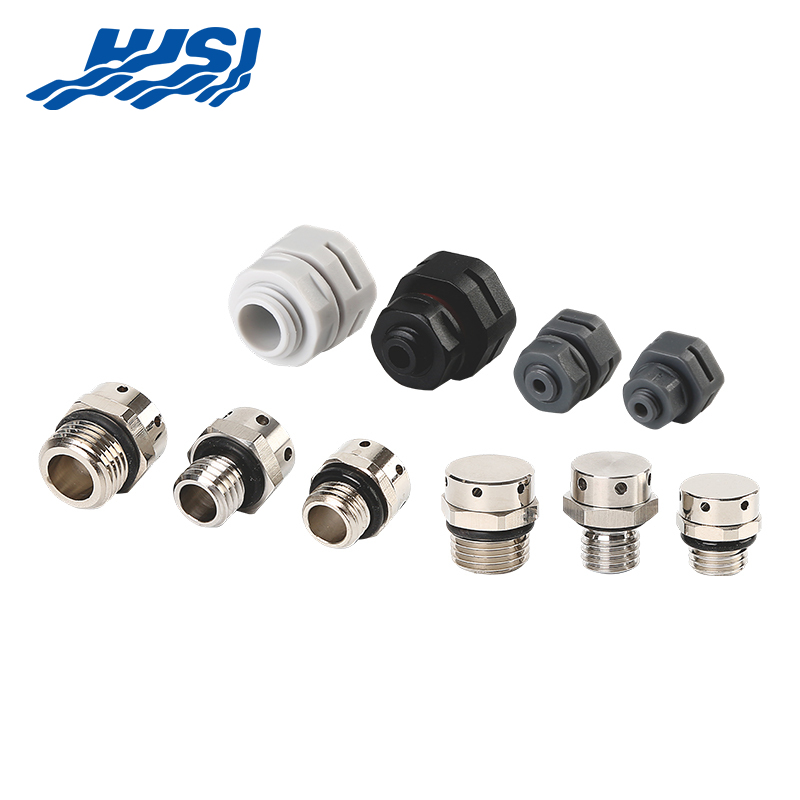
LED enclosures fog up. Not from rain - from the temperature cycles that happen every time the luminaire powers on, warms up, shuts down, and cools overnight. Air trapped inside the enclosure holds moisture. When that air cools, the moisture condenses on lenses and circuit boards. Sealing the enclosure tighter does not solve the problem - it makes it worse, because sealed air cannot exchange with drier outside air and pressure differentials build up with every thermal cycle. A Waterproof Breathable Valve is the component that breaks this cycle: it allows air and water vapor to move in and out while physically blocking liquid water, dust, and particulates. Selecting the right one for an outdoor LED enclosure involves more than picking an IP-rated part from a catalog.
Outdoor LED fixtures heat up during operation and cool when the power goes off. Inside the housing, this temperature swing changes the air pressure. Warm air at operating temperature creates positive pressure inside the enclosure. When the fixture cools, that pressure drops below ambient - and the enclosure effectively tries to breathe inward through whatever path it can find.
If the only paths available are imperfect gaskets or cable gland interfaces, the enclosure draws moisture-laden air through those paths under negative pressure. The ingress is not dramatic - it does not flood the enclosure. But small amounts of moisture drawn in repeatedly accumulate over time, and there is nowhere for the condensation to go.
A breathable vent valve provides a controlled path for this pressure exchange. The pressure equalizes through the membrane rather than through the sealing interfaces, which protects both the seals and the internal components.
The damage is not always visible. Condensation on a PCB changes the electrical properties of the board surface - trace resistance increases, insulation resistance drops, and over time ionic contamination from the board's own surface chemistry concentrates where the moisture sits. Driver failures, LED flickering, and premature lumen depreciation often trace back to moisture that was never prevented at the design stage.
Lenses fog from the inside. This reduces output, changes the beam pattern, and cannot be cleaned without opening the enclosure. For street lighting, facade illumination, or outdoor displays, fogging is a product failure visible to end users.
The functional core of any breathable vent is a microporous membrane, typically made from expanded polytetrafluoroethylene. The pore structure of this membrane is sized to allow gas molecules - including water vapor - to pass through freely in both directions while physically blocking liquid water droplets, which are orders of magnitude larger than vapor molecules.
This is a structural property of the membrane itself, not a chemical coating that wears away. The membrane does not absorb water - it repels it while remaining permeable to air. The result is a component that simultaneously provides pressure equalization, moisture vapor exchange, and liquid water ingress protection.
The housing around the membrane protects it mechanically and determines how the valve is mounted in the enclosure wall.
When the enclosure temperature rises during operation, the internal pressure increase vents outward through the membrane. When the enclosure cools, outside air enters through the same path. The exchange is gradual and controlled - not a sudden pressure event.
The rate at which this exchange occurs depends on the membrane's air permeability and the valve's cross-sectional open area. For a broad range of outdoor LED enclosure volumes, the equalization happens quickly enough to prevent significant pressure differential from building up across thermal cycles.
The valve's IP rating must be compatible with the enclosure's target protection level. A common misconception is that adding a breathable valve to an IP67 or IP68 enclosure compromises its ingress protection rating. A correctly specified valve maintains the enclosure's IP rating - it provides ingress protection at the same level or higher than the enclosure's rated level.
Confirm this with the valve supplier. Not all breathable vents carry the same IP certification, and using a lower-rated valve on a higher-rated enclosure creates a gap in the protection system.
Outdoor LED enclosures come with pre-drilled or pre-threaded ports sized for specific valve formats. The valve thread must match the port thread in both size and type. Mismatched threads either fail to seal or require adapters that introduce additional leak paths.
Common mounting formats:
For luminaire applications where the valve is installed during manufacturing, threaded barrel formats with integrated O-ring sealing are the standard approach. Self-adhesive formats are more common in retrofit situations.
Outdoor LED enclosures operate across a wide temperature range - from well below zero in cold-climate installations to elevated temperatures inside enclosures mounted on south-facing walls in sunny climates. The valve housing material must remain dimensionally stable and chemically inert across this range.
Plastics that perform adequately at room temperature can become brittle at low temperatures or soften and deform at elevated temperatures. UV exposure degrades many plastic formulations over time, which affects both the housing's mechanical properties and its color stability.
Stainless steel housings or UV-stabilized engineering plastics are the standard choices for outdoor applications. If the installation environment involves salt spray - coastal installations, road-side luminaires subject to winter de-icing chemicals - confirm that the housing material's corrosion resistance covers these conditions.
The valve's airflow rate determines how quickly the internal pressure equalizes after a temperature change. For smaller enclosures, lower airflow valves are adequate. Larger volumes, or enclosures that experience rapid temperature changes, need higher airflow capacity to equalize within the thermal cycle.
Suppliers typically provide airflow rate at a defined differential pressure. Use this value to estimate whether the valve will equalize the enclosure volume within the relevant time window. An undersized valve may still provide pressure equalization, but slowly - allowing temporary pressure differentials to build before they dissipate.
A side-by-side comparison of the main configuration options helps narrow the choice for a specific application:
| Valve Type | Mounting Method | UV Resistance | IP Rating | Airflow Capacity | Suitable For |
|---|---|---|---|---|---|
| Threaded barrel, plastic housing | Threaded port | Moderate — check specification | Up to IP68 depending on product | Variable | Standard luminaire manufacturing |
| Threaded barrel, stainless steel | Threaded port | High | Up to IP68 | Variable | Coastal, industrial, aggressive environments |
| Self-adhesive patch vent | Adhesive to flat surface | Moderate to high | Typically IP54–IP66 | Lower | Retrofit, cable boxes, control panels |
| Push-fit snap-in | Pre-formed port | Variable | Variable | Variable | High-volume production assembly |
| High-flow breathable cap | Threaded or bayonet | Variable | Typically IP54–IP66 | Higher | Larger enclosure volumes, faster equalization needed |
Breathable valves vary significantly in material quality at similar price points. A lower-cost plastic housing valve may look identical to a UV-stabilized version but degrade substantially faster in field conditions. Membrane quality also varies - not all ePTFE membranes are manufactured to the same pore structure specification, and differences in hydrophobic performance only become apparent after extended outdoor exposure.
Ask for material specifications and UV resistance data. For long-life luminaire applications where a service call is expensive, specifying a valve that lasts as long as the fixture is worth the additional effort in the selection process.
The valve housing is designed to shed water, but this assumes the valve is installed in an orientation where gravity works in its favor. A valve installed on the bottom face of the enclosure in a position where water can collect against the membrane face is working against its own design.
Position the valve on a side face of the enclosure, with the membrane face oriented so water runs off rather than accumulating. The installation orientation affects field performance significantly, even for valves with strong IP ratings.
For elongated or compartmentalized enclosures - road lighting fixtures with driver and optics in separate zones, for example - a single valve at one end may not equalize pressure throughout the internal volume effectively. The pressure gradient across a long housing can leave the far end improperly equalized even when the valve is functioning correctly.
In these cases, placing valves at each end of the enclosure, or at each zone in a compartmentalized design, provides more even pressure management across the full internal volume.
For LED luminaire applications supplied into regulated markets, the valve's compliance with relevant IP testing standards needs documentation. IP rating claims without supporting test documentation do not satisfy the certification requirements of the majority of lighting product standards.
Request the IP test report for the valve in its installed configuration - not just the IP rating stated on the product label. The installed performance can differ from the component-level rating depending on how the valve interfaces with the enclosure wall.
In a long-life luminaire application, the valve may need replacement over the fixture's service life. Confirming that the supplier can provide the same specification product over a multi-year horizon avoids the situation where a replaced valve differs dimensionally or in performance from the original.
For OEM manufacturers specifying valves into product lines with multi-year production runs, long-term supply agreement discussions with the supplier are worthwhile upfront.
Selecting a Waterproof Breathable Valve for an outdoor LED enclosure involves matching IP rating, airflow capacity, material specification, mounting format, and installation orientation to the specific thermal and environmental demands of the application. A component that satisfies one of these criteria while falling short on another creates a protection gap that will only become visible in field conditions - usually after a substantial number of units are already installed. Zhejiang HJSI Connector Co., Ltd. supplies Waterproof Breathable Valve products for outdoor LED, electrical enclosure, and industrial protection applications, with technical support covering IP rating selection, thread specification, material compatibility, and airflow sizing for different enclosure volumes. If you are specifying valves for a new luminaire design, evaluating replacement options for an existing product line, or sourcing for a volume production program, reaching out with your enclosure dimensions, target IP rating, operating temperature range, and installation environment gives the engineering team the information needed to recommend an appropriate configuration. The difference between a valve that performs across the service life of the fixture and one that fails early comes down to specification quality - and that starts at the selection stage.

2nd Floor, Building 2, No. 188, Punan 3rd Road, Economic Development Zone, Yueqing City, Wenzhou City, Zhejiang Province, China

Copyright @ Zhejiang HJSI Connector Co., Ltd. All rights reserved.

China Waterproof Breathable Valve Manufacturer
 +86-15858552966
+86-13356176555
+86-15858552966
+86-13356176555
 English
 русский
 عربى
عربى