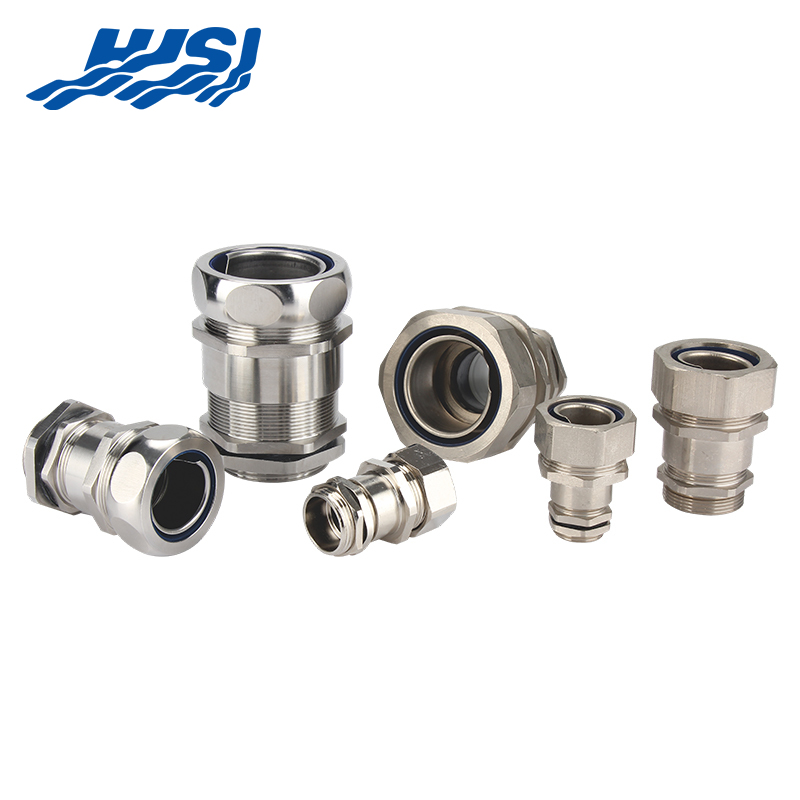
Cable glands serve as essential entry points where electrical cables pass through enclosures, panels, junction boxes, or equipment housings. Their primary role is to anchor the cable securely, relieve mechanical strain on terminations, and create a barrier against dust, moisture, chemicals, or other contaminants that could reach internal wiring or components. In applications involving flat cables—those with a wide, ribbon-like cross-section—the gland must grip the cable evenly without distorting its shape or pinching individual conductors. Double compression nickel-plated brass flat cable gland address these requirements through a design that applies controlled pressure at two distinct points along the cable, providing a firm hold and a reliable seal.
Flat cables appear frequently in situations where space is limited or where a low-profile connection is needed. Examples include control panels with densely packed wiring, lighting fixtures with ribbon conductors, certain types of instrumentation harnesses, and equipment that requires flexible routing within tight enclosures. Unlike round cables, flat cables resist twisting but can be more vulnerable to crushing or deformation if compressed unevenly. The double compression mechanism helps distribute force across the cable's width, maintaining conductor alignment and preventing insulation damage.
The gland body is typically machined from brass, a material valued for its strength, machinability, and natural corrosion resistance. Brass allows for precise thread cutting and smooth surfaces that resist galling during tightening. Nickel plating is applied over the brass to form a thin, hard, protective layer. This coating improves resistance to oxidation, tarnishing, and chemical attack while maintaining good electrical conductivity for grounding purposes. The combination results in a gland that withstands exposure to humidity, mild acids, oils, and industrial atmospheres without rapid degradation.
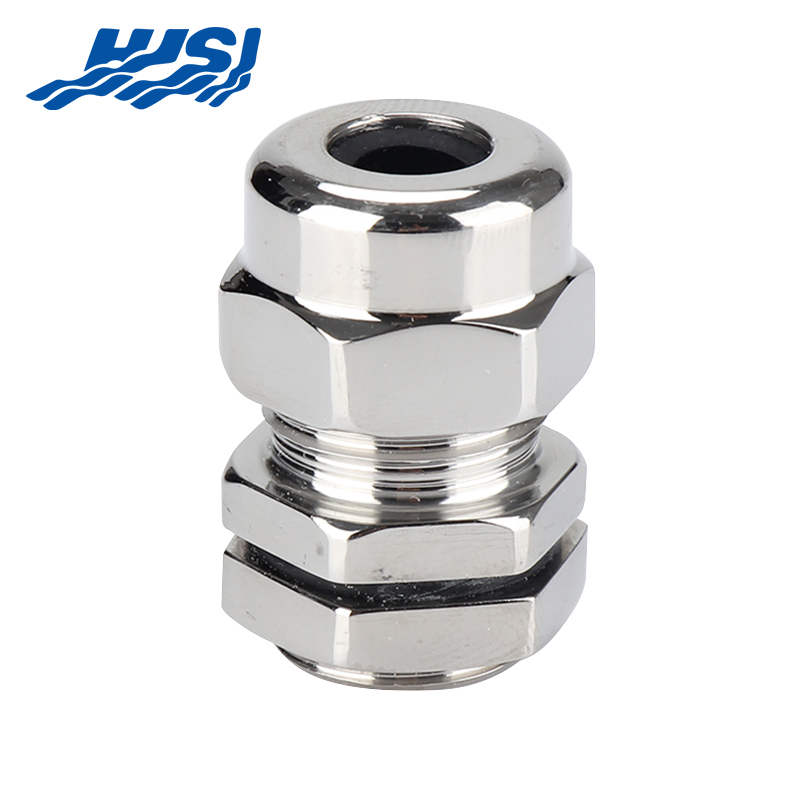
The double compression feature is the defining characteristic. The gland consists of a main body with an entry thread for the enclosure, a middle section with two compression nuts, and an exit thread or clamping area for the cable. The first compression (outer) grips the cable's outer sheath, while the second (inner) clamps closer to the conductors or armor layer. When tightened, both nuts compress elastomeric seals or grommets, creating two independent sealing zones. This arrangement achieves higher ingress protection than single-compression glands, particularly on flat cables where one compression point might leave gaps along the edges.
Strain relief is another critical function. Mechanical pull on the cable—whether from equipment movement, vibration, or accidental tugs—transfers to the gland rather than the terminations. The double compression distributes this load, reducing the likelihood of conductor breakage or insulation failure at the connection point. In systems with frequent vibration, such as motor control cabinets or conveyor controls, this strain relief helps maintain long-term electrical continuity.
| Aspect | Key Mechanism / Feature | Benefit / Outcome |
|---|---|---|
| Source of Mechanical Pull | Equipment movement, vibration, accidental tugs | Real-world stresses on cable during operation or handling |
| Load Transfer | Pull force directed to the gland (not terminations) | Protects connection points from direct stress |
| Double Compression Role | Two compression zones distribute force evenly | Prevents concentrated load → reduces conductor breakage risk |
| Insulation & Conductor Protection | Even pressure across cable width | Minimizes insulation damage or pinching on flat cables |
| Vibration-Heavy Applications | Motor control cabinets, conveyor controls, etc. | Maintains long-term electrical continuity and joint reliability |
| Overall Result | Strong strain relief built into gland design | Longer service life, fewer failures from pull or vibration |
The gland's seal also blocks contaminants. Dust, water droplets, oil mist, or chemical vapors can enter through cable entry points if the gland does not seal properly. The dual compression, combined with appropriately shaped grommets or seals, creates a barrier that meets common ingress protection requirements for industrial and outdoor use. In environments where washdowns occur or where condensation forms inside panels, this sealing helps prevent corrosion of internal components or short circuits.
Sizing flexibility is built into the design. Glands are produced in a range of thread sizes and cable entry openings to accommodate different flat cable widths and thicknesses. This range allows installers to match the gland to the cable without excessive compression that could damage the flat structure. The glands fit standard enclosure knockouts, making them compatible with existing panels and boxes.
In industrial settings, these glands secure cables in motor control centers, switchgear cabinets, and automated assembly equipment. Vibration from motors or actuators can loosen single-compression glands over time, but the dual mechanism holds the cable more securely. The nickel plating resists oils, coolants, and cleaning agents used in manufacturing, maintaining the gland's appearance and function. In food processing or pharmaceutical facilities, where hygiene is important, the smooth, corrosion-resistant surface simplifies cleaning and reduces the risk of contaminant buildup.
Automated machinery and robotics rely on glands to protect cables that move through joints or along arms. Flat cables often carry power and signals in these systems because they bend easily in one plane. The double compression prevents the cable from slipping during rapid acceleration or deceleration, preserving signal integrity and preventing conductor fatigue. The gland's strength ensures it withstands the mechanical stresses of repeated motion.
In telecom racks, distribution frames, and data center cabinets, these glands secure flat cables at entry points. They keep grounding continuous through the metal body and stop dust from getting inside sensitive gear. For outdoor telecom cabinets or base stations, the nickel plating stands up to weathering—rain, sun, temperature swings—while the double seal blocks humidity and condensation from reaching the equipment.
Salt air and occasional water splash are tough on metal parts. Nickel-plated brass holds up better than plain brass or uncoated metals against pitting and rust in those conditions. On ships, docks, or coastal sites, the glands protect flat cables from corrosion and keep water out of junction boxes or control panels. In outdoor electrical cabinets, solar inverters, or lighting control boxes, they shield the cable from rain and dew, cutting down on the chance of shorts or ground faults.
Pick the gland that matches the flat cable's width and thickness and fits the enclosure's thread size. Cut the cable to length, then feed it through the gland body. Strip back the outer sheath only as far as needed to reach the conductors. Slide the cable through the outer compression nut first and tighten it to grip the sheath firmly. Then position the inner conductors (or any armor/foil layer) in the second compression zone and tighten the inner nut. Use even, moderate torque—over-tightening can damage the cable or crush the seal. In damp locations, add thread sealant to the enclosure entry for extra protection. Always support the cable close to the gland so pull forces don't act directly on the terminations.
Check the glands regularly: look for loose nuts, early signs of corrosion, cracked seals, or damage from impact/abrasion. If vibration has backed off the nuts, snug them up again. Wipe off dust, oil, salt residue, or other buildup that could break down the seal over time. In tough environments—coastal, chemical plants, high-humidity areas—inspect more often. If you see serious pitting, seal failure, or cracking, replace the gland immediately rather than risk a leak or loose cable.
| Maintenance Task | What to Check / Do | Frequency / Condition | Action if Issue Found |
|---|---|---|---|
| Visual Inspection | Loose nuts, early corrosion, cracked seals, impact/abrasion damage | Regularly (monthly or per maintenance schedule) | Retighten loose nuts; clean; replace if damage is serious |
| Nut Tightness (vibration-related) | Nuts backed off from vibration | After initial run-in + periodically in vibrating areas | Snug up nuts to proper torque (avoid over-tightening) |
| Surface Cleaning | Dust, oil, grease, salt residue, chemical buildup | Regularly, more often in dirty/coastal/chemical areas | Wipe clean to prevent seal degradation |
| Environmental Exposure | Harsh conditions (coastal salt air, chemical plants, high humidity) | Increase inspection frequency in these environments | Replace gland if pitting, seal failure, or cracking appears |
| Critical Failure Signs | Serious pitting, complete seal failure, visible cracking | Immediate check if suspected | Replace gland right away — do not risk leak or loose cable |
The double compression stops the cable from pulling out and exposing live conductors. The seal keeps water and contaminants from entering the enclosure, lowering the risk of shorts, corrosion inside the panel, or ground faults. In chemical areas, it helps contain any cable compromise and prevents leaks from spreading. Because they last longer than single-compression glands in harsh conditions, replacement frequency drops, cutting maintenance labor and parts costs.
The double mechanism gives a much stronger grip on flat cables, which can slip or twist more easily than round ones. Nickel plating makes the gland hold up longer in corrosive or salty air than plain brass. The flat-specific design avoids the pinching or distortion that a round gland can cause on ribbon cables, keeping the conductors straight and undamaged.
These glands are reasonably priced to produce thanks to straightforward machining and plating. Installation goes quickly once you have the right size—no special tools beyond a wrench—so labor stays low even on big jobs. Their longer service life means you replace them less often, which saves money over time. In plants or facilities where downtime costs a lot, the extra reliability pays for itself by keeping systems running without unexpected interruptions.
Sizing is critical—pick the wrong gland and it either won't seal properly or it will squeeze the cable too hard and damage it. In very high-temperature areas the brass and seals can soften, though they handle normal industrial and outdoor ranges without trouble. Training installers to use the right torque avoids under-tightening (loose cable) or over-tightening (crushed seal or pinched conductors).
Zhejiang HJSI Connector Co., Ltd.
Double-compression nickel-plated brass flat cable glands provide a practical and durable solution for cable entry points in enclosures, control panels, and equipment housings, securing and protecting flat cables. Their double-compression mechanism evenly clamps the cable, providing robust strain relief and effective sealing against dust, moisture, and chemical ingress. The nickel-plated brass construction offers corrosion resistance and maintains grounding continuity under harsh conditions. From industrial machinery and automation systems to outdoor telecommunications cabinets, marine equipment, and electrical panels exposed to harsh weather or vibration, these glands help prevent cable pull-out, conductor damage, and environmental intrusion that could lead to malfunctions or downtime.
HJSI cable glands feature precision machining for consistent thread quality; a uniform nickel plating for reliable corrosion protection; and a precisely sized compression area that perfectly matches the flat cable profile; and robust seals that maintain integrity under mechanical stress and environmental exposure. HJSI focuses on ease of installation, reliable long-term retention capabilities, and resistance to real-world challenges such as vibration, moisture, and occasional impacts, reducing the need for frequent replacements, minimizing installation and maintenance efforts, and ensuring that cabling systems remain protected and operational over a long service life. Choosing HJSI means choosing cable glands designed to meet the practical needs of industrial, outdoor, and specialized installations, ensuring safe, compliant, and efficient cable management day after day.

2nd Floor, Building 2, No. 188, Punan 3rd Road, Economic Development Zone, Yueqing City, Wenzhou City, Zhejiang Province, China

Copyright @ Zhejiang HJSI Connector Co., Ltd. All rights reserved.

China Waterproof Breathable Valve Manufacturer
 +86-15858552966
+86-13356176555
+86-15858552966
+86-13356176555
 English
 русский
 عربى
عربى